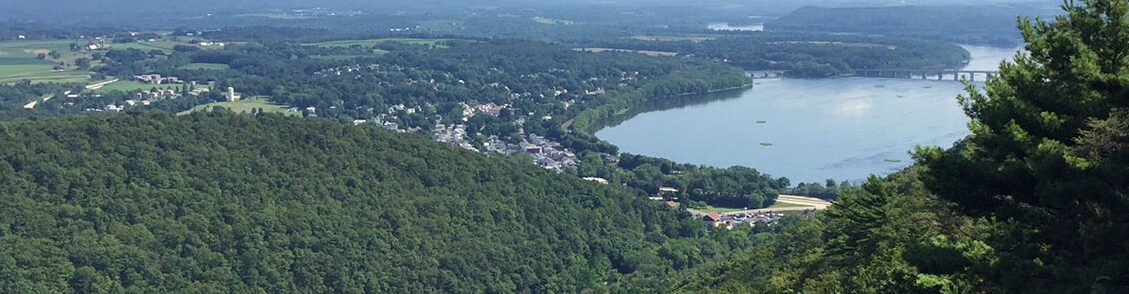

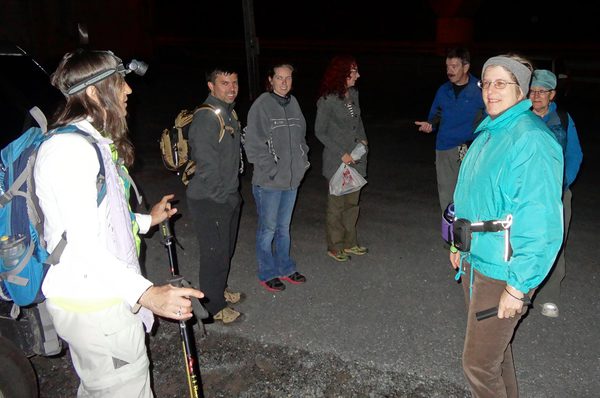
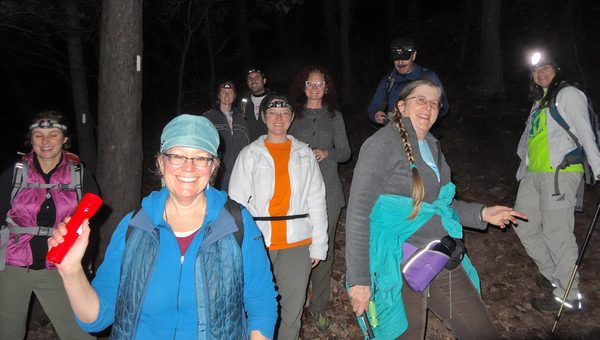
 Our moonlight hike was a success even though Mother Nature did not cooperate. We rescheduled for Sunday and had clear skies and a beautiful view of the Moon and the valley below. We also had quite a surprise when two shining eyes observed us very closely from a bush along the trail. Fortunately, it was a deer blinded by our lights and just stood there for us to observe. At least it wasn’t a coyote or bear.
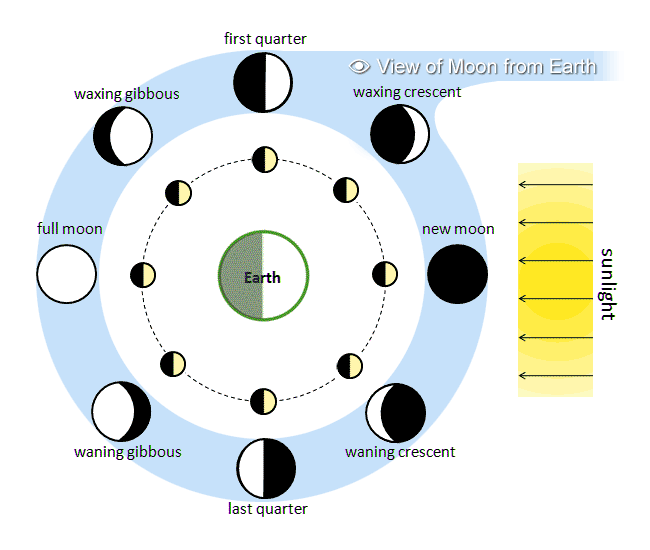
Once at the top of Peter’s Mt. the 8 phases of the Moon and other aspects were discussed: The lunar phases are created by changing angles of the Earth, Moon and Sun as the Moon orbits the Earth. Starting with the New Moon, when the Moon is between the Earth and Sun with the lit side facing away from Earth, the moon is dark and cannot be seen easily. The next phase, the Waxing Crescent, is a sliver of light less than half full. ( Waxing means getting larger with crescent meaning less than half.) The 3rd phase, the 1st quarter or half moon, is just that half full. (Quarter refers to the extent of the Moon’s cycle around the Earth, not its shape.) Waxing Gibbous is the 4th phase with gibbous meaning more than half. The Full Moon phase is the 5th phase, with the Earth between the Sun and Moon, and from that point the Moon begins to wane, decrease in size. From there you have the Waning Gibbous, 6th phase, Third Quarter, 7th phase, and Waning Crescent your last phase. These are the 8 phases of the moon in the Western Culture. Non – Western cultures may use a different number of Moon phases, for example there are a total of Continue reading